
← Previous Work: ECHIZEN MANDALA Next Work: MOMENT →
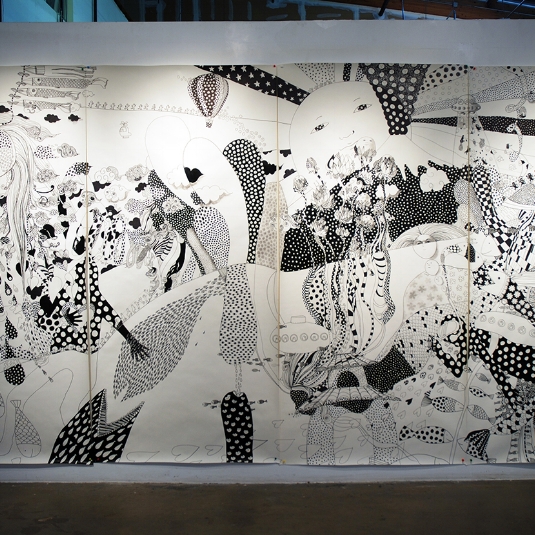
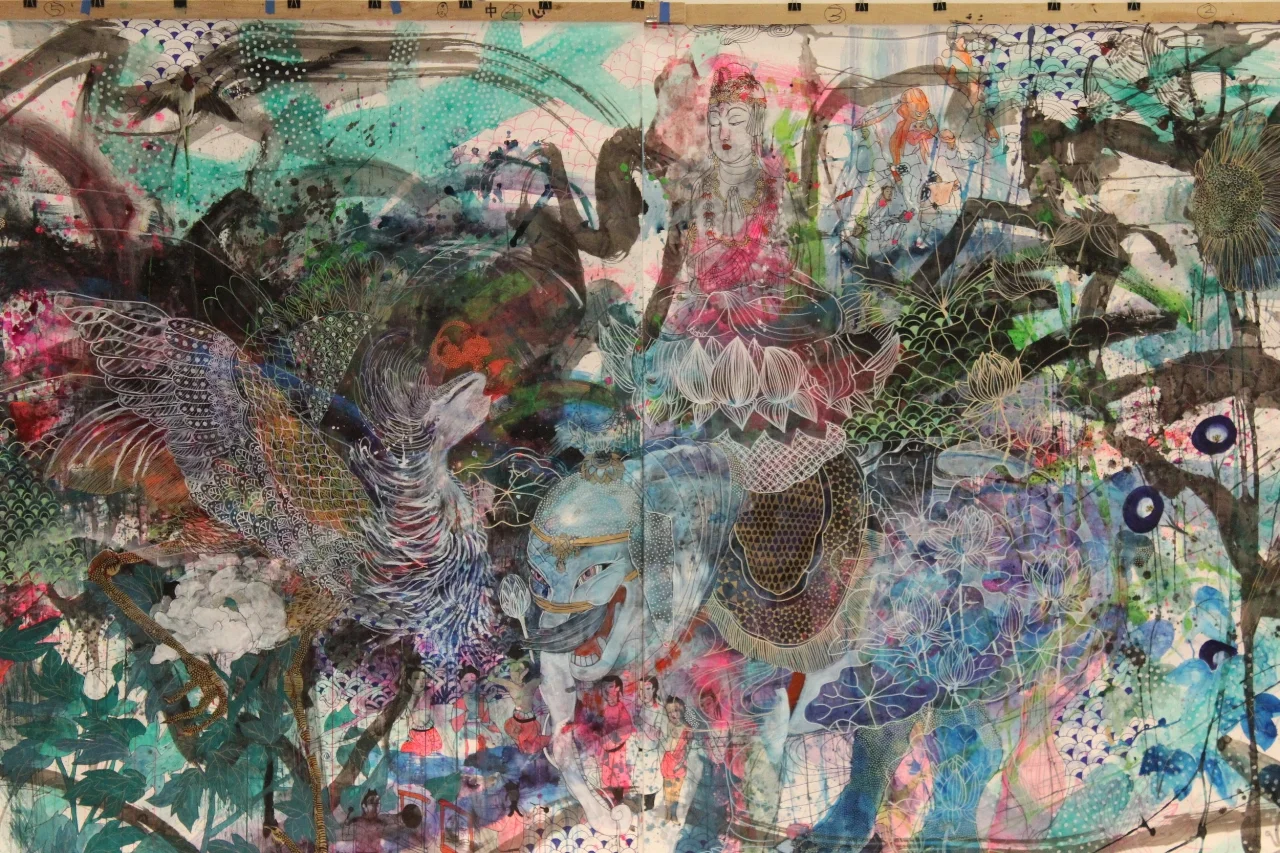
One trifle-beset night, t’was the moon, not I, that saw the pond lotus bloom
おのづから月宿るべき隙もなく池に蓮の花咲きにけり(西行)
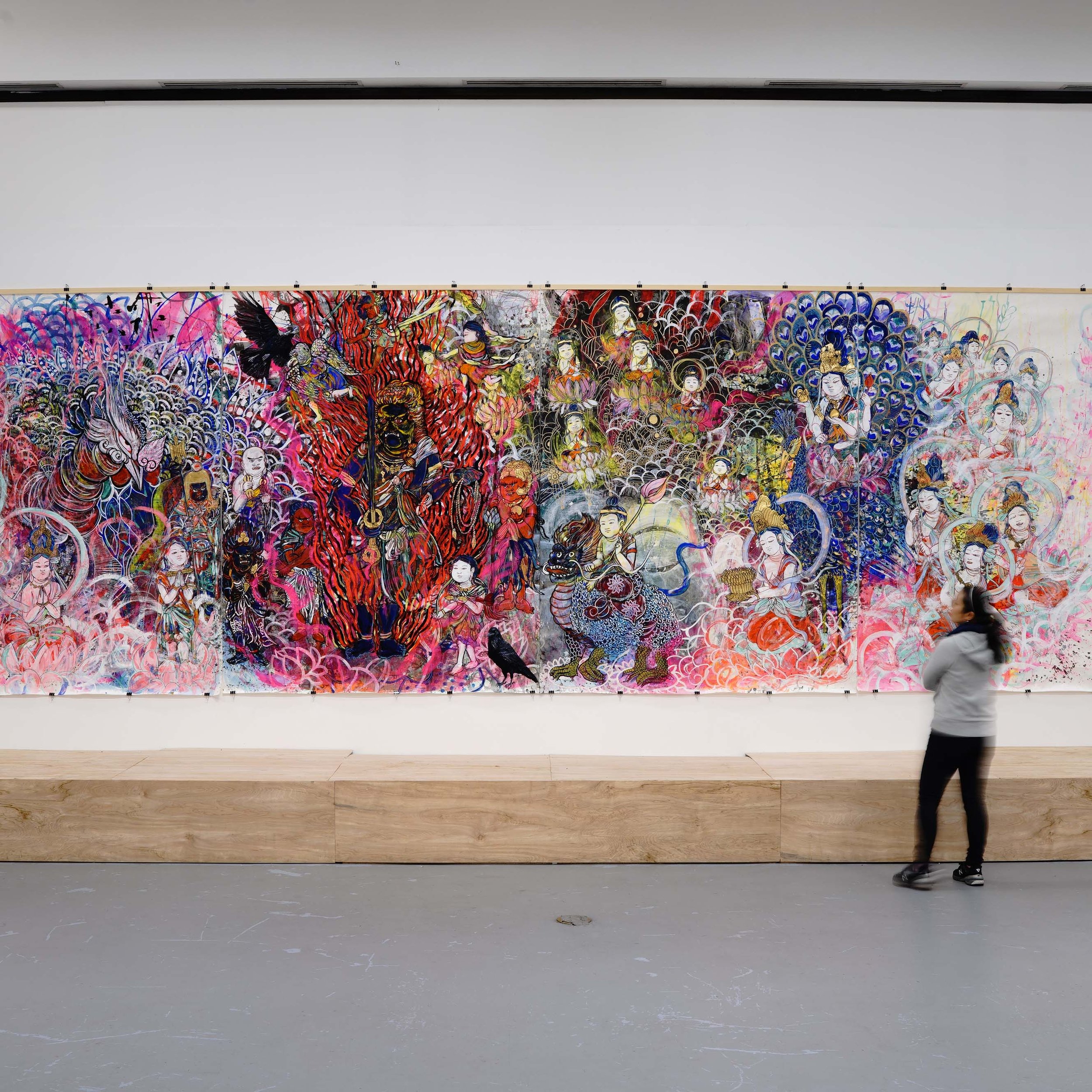
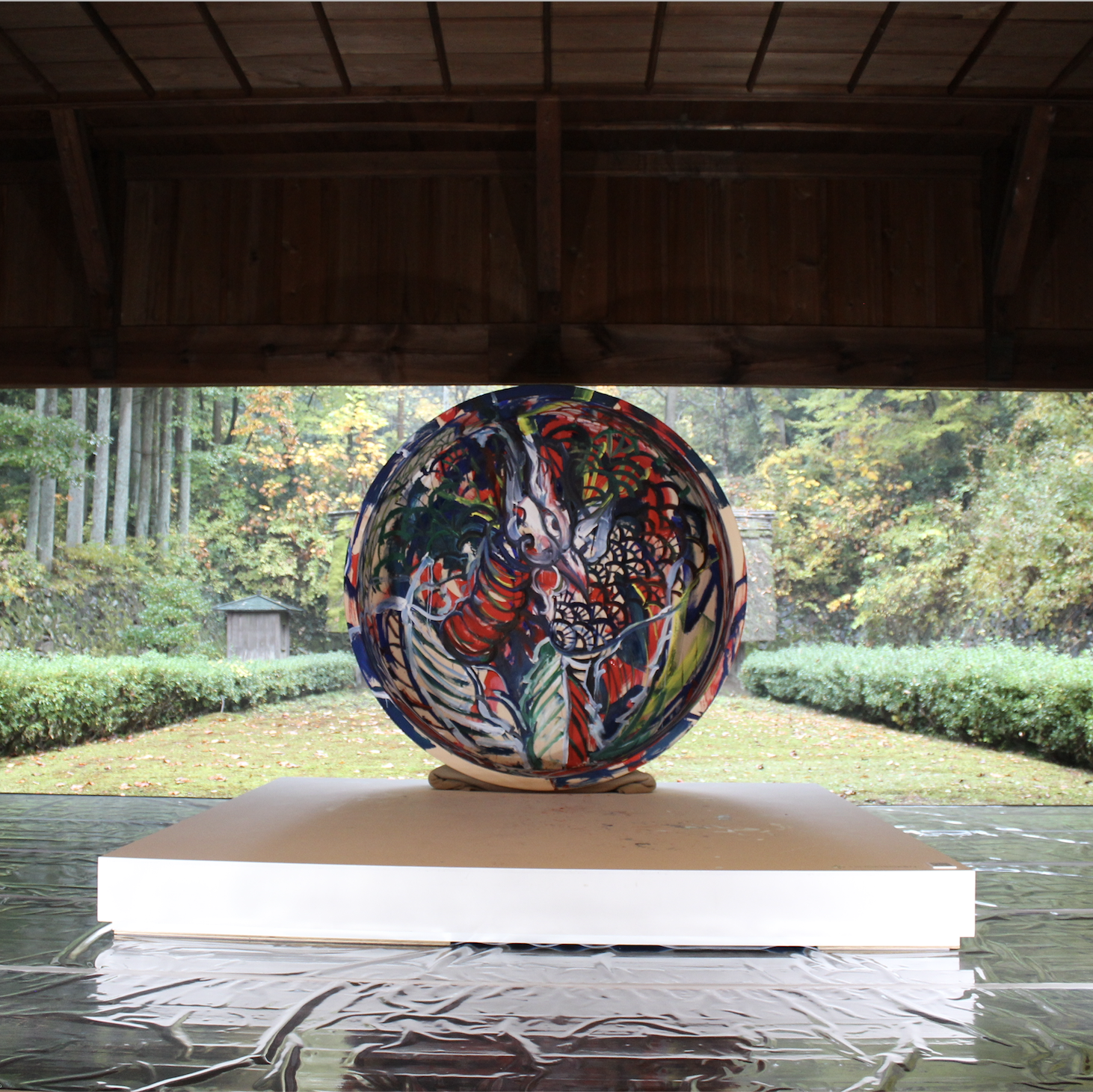
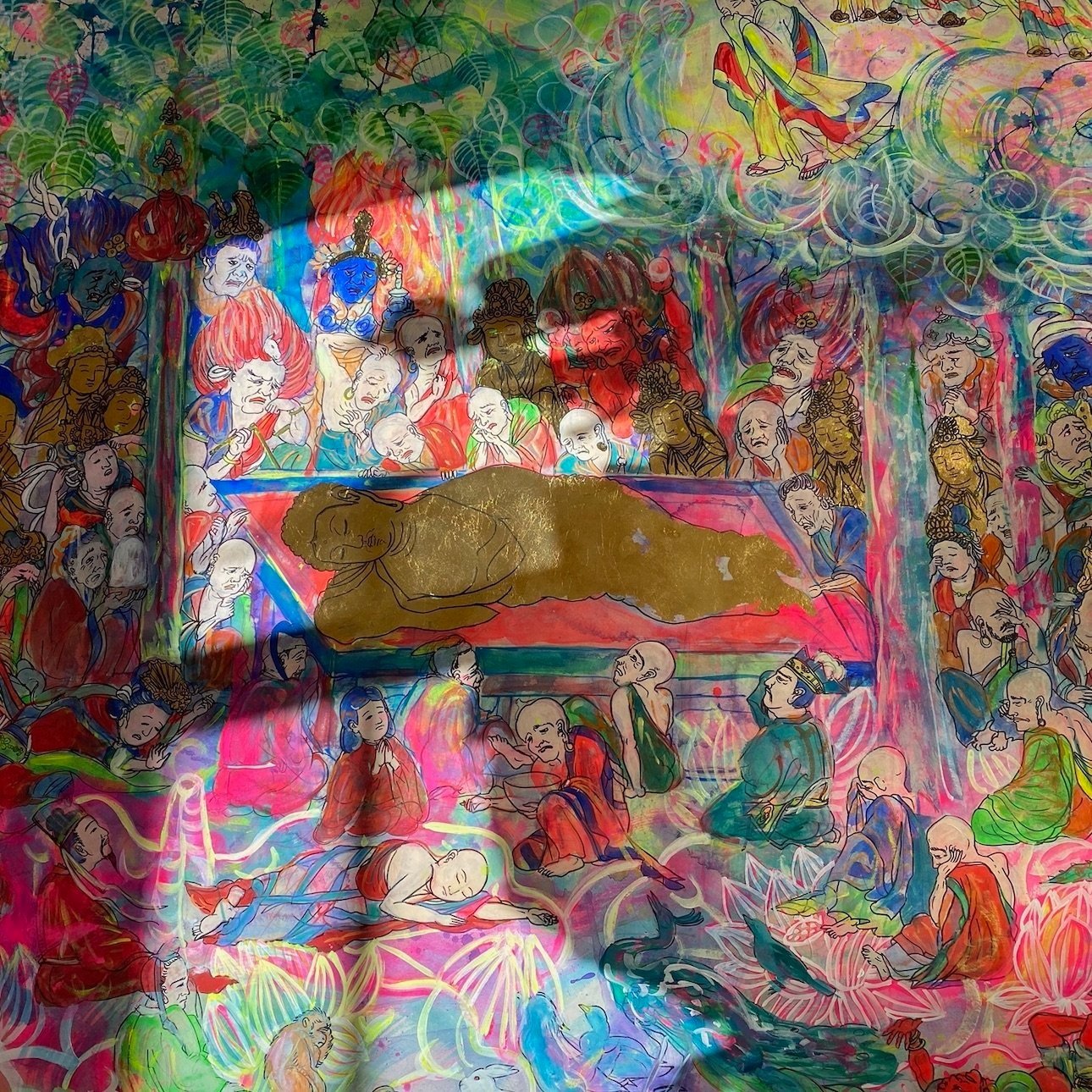
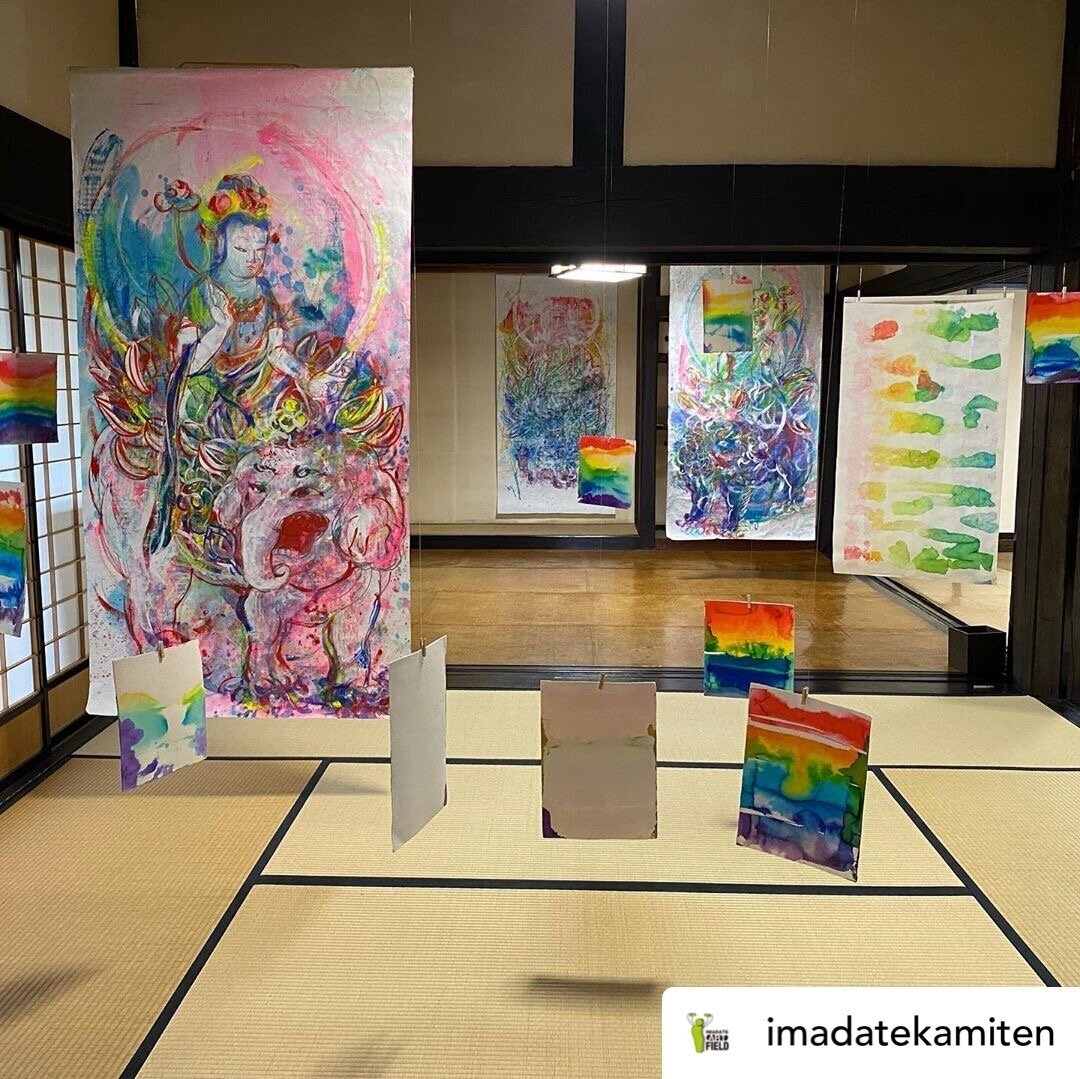
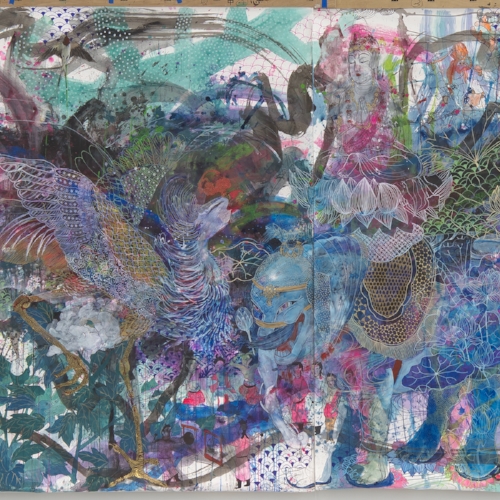
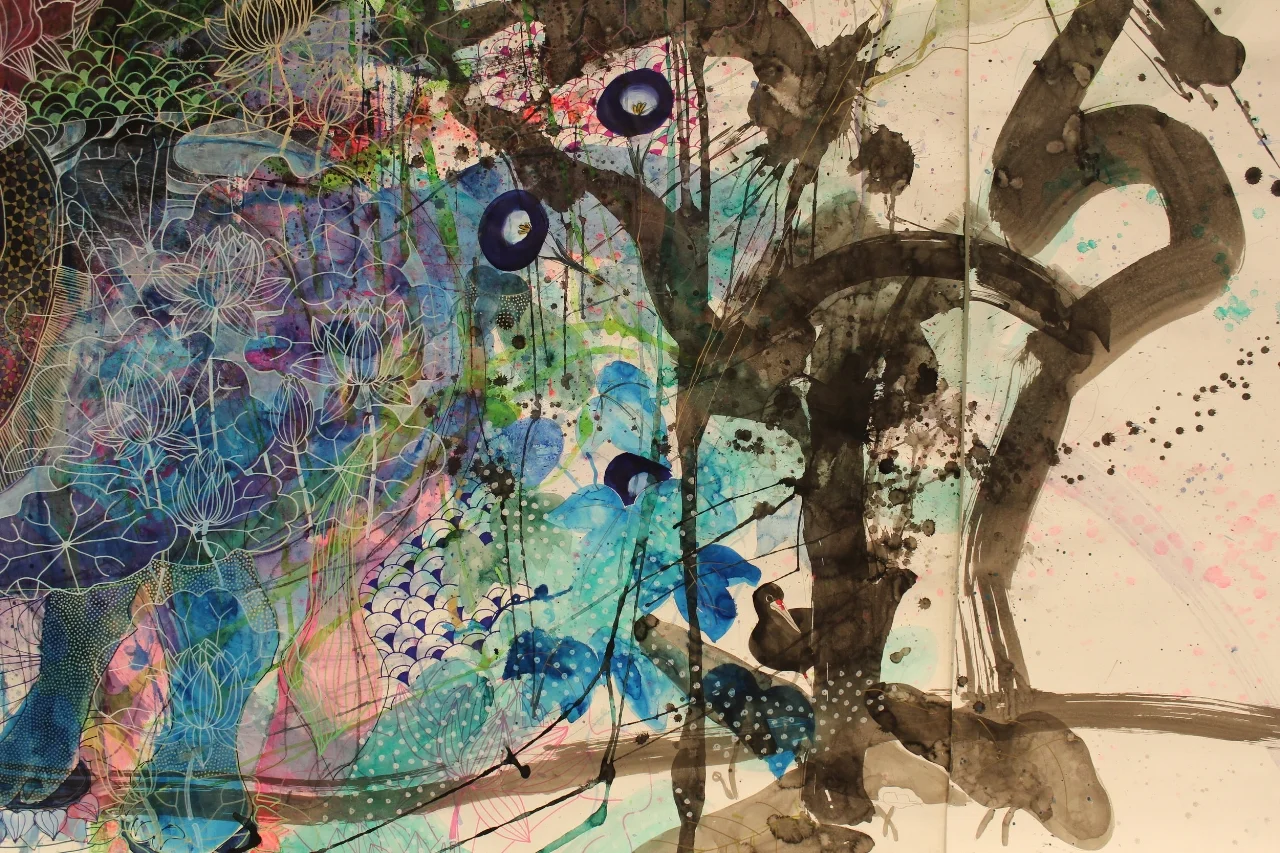
Watercolor, Sumi ink, Marker, Acrylic color, Vinyl color on Washi Paper (Daitoku Roll, Machine made in Fukui Prefecture, Japan, Hiromi Paper Inc.)
98 in x 308 in total; four panels: 98 in x 77 in each.
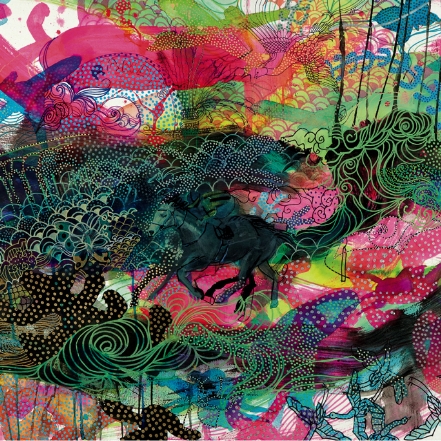
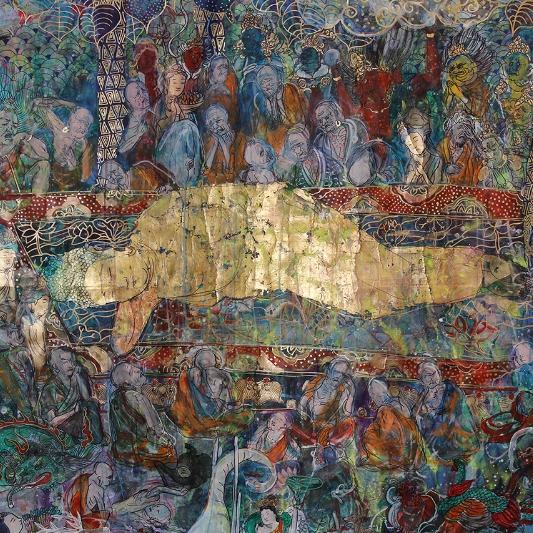
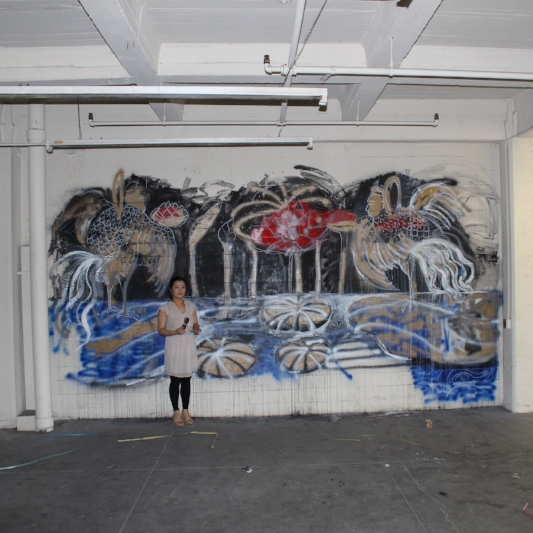
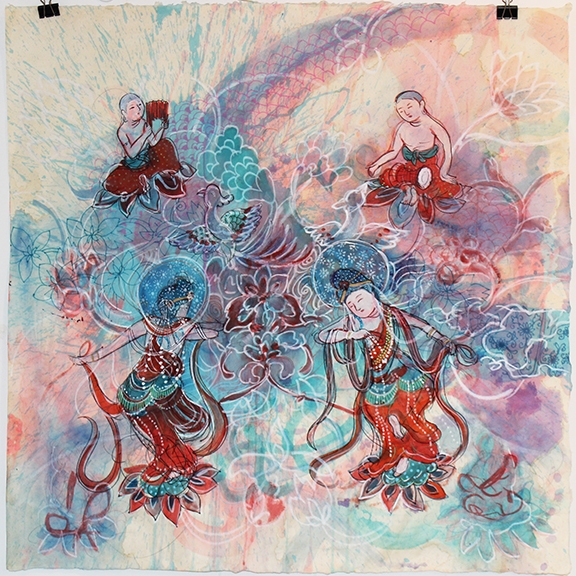
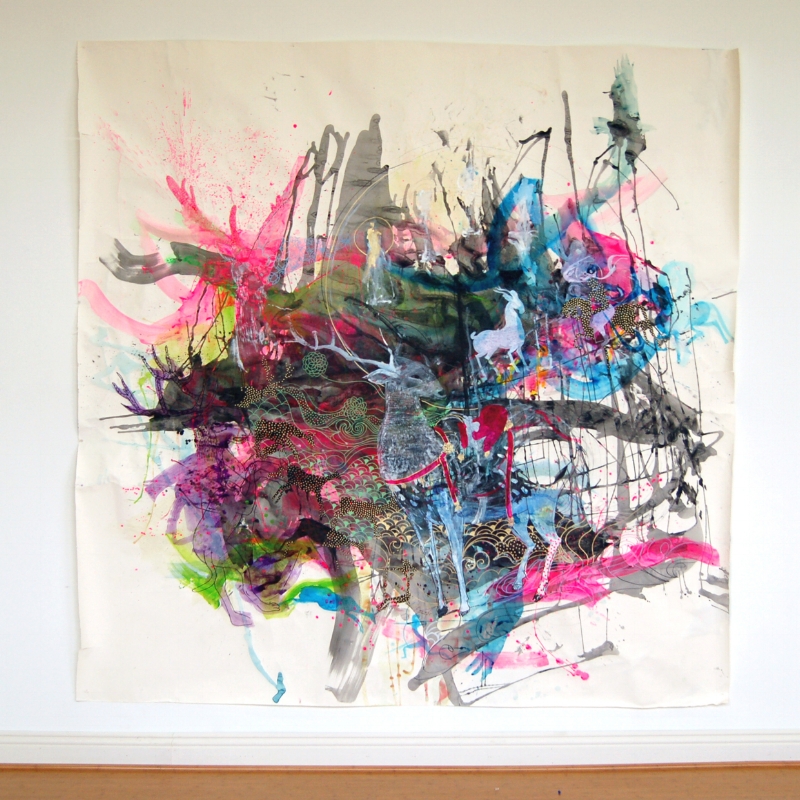
Created for R.S.V.P. Los Angeles: The Project Series at Pomona in 2015, this monumental four-panel painting marks a turning point in my practice—from the visual chaos of CHARACTER toward a contemporary engagement with Buddhist painting on Japanese washi.
2015年、ポモナ大学美術館の展覧会「R.S.V.P. Los Angeles」のために制作した4面構成の大作です。CHARACTERで展開した視覚言語とカオスから、越前和紙を用いて仏画へ現代美術の視点から接近する、私の制作における転換点となりました。




A Painting Between Chaos and Prayer
I created One trifle-beset night, t’was the moon, not I, that saw the pond lotus bloom for R.S.V.P. Los Angeles: The Project Series at Pomona, presented at the Pomona College Museum of Art in 2015. To commemorate the fiftieth Project Series exhibition, seven former participating artists were invited to nominate two emerging or lesser-known Southern California artists. Seven artists were ultimately selected to present new or recent work.
This four-panel painting was created specifically for the exhibition. It marked an important transition in my practice. In CHARACTER, I had developed a visual language of figures, fragments, and signs on drawing paper, building a field of deliberate chaos. With this work, I carried that language onto Japanese washi and began approaching Buddhist painting through the perspective of contemporary art.
At the time, I was working as a curator at the Japanese American Cultural & Community Center and helping organize The Price Collection: Heart of Beautiful Japan. Through the generosity of Etsuko and Joe Price, I was able to study original paintings by masters including Itō Jakuchū and Sakai Hōitsu at close range while developing this work. Their paintings were not models to be copied, but living presences that opened another way of understanding line, space, nature, and spiritual attention.
The title derives from a poem by the Buddhist poet Saigyō:
Onozukara tsuki yadorubeki hima mo naku
ike ni hachisu no hana saki ni keri
One trifle-beset night, t’was the moon, not I, that saw the pond lotus bloom.
The English rendering was created by David McLeod. The poem describes a pond so completely filled with lotus blossoms that no open space remains for the moon’s reflection. For me, this image became a way to think about perception: the moon is present, yet it cannot be possessed by the one who looks.
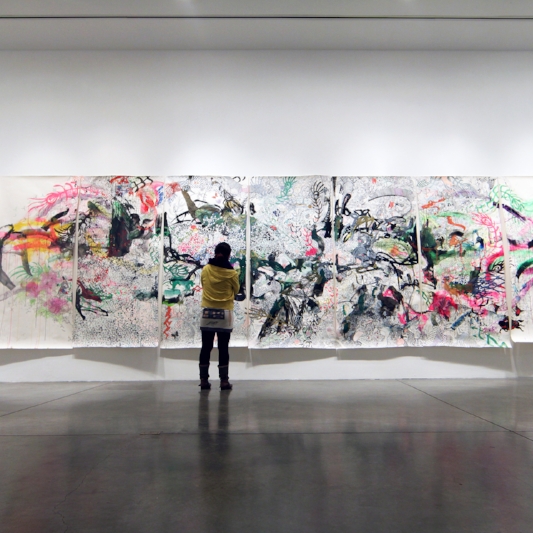
The painting was installed in the same gallery space as I (2010), a video lasting more than four hours. Together, the monumental stillness of the painting and the extended duration of the video formed a single installation—bringing image, repetition, time, and contemplation into the same space.
Back to Top ↑
カオスから祈りへ
One trifle-beset night, t’was the moon, not I, that saw the pond lotus bloomは、2015年にポモナ大学美術館で開催されたR.S.V.P. Los Angeles: The Project Series at Pomonaのために制作した作品です。Project Series第50回を記念し、過去に参加した7名の作家が、それぞれ南カリフォルニアで活動する若手またはまだ広く知られていない作家2名を推薦し、その中から選ばれた7名による展覧会でした。
この4面構成の大作は、展覧会のために新たに制作しました。それまでのCHARACTERでは、ドローイングペーパーの上に人物、断片、記号を重ね、視覚言語による意図的なカオスを作り出していました。本作では、その言語を日本の和紙へ移し、仏画というものに現代美術の視点からアプローチし始めました。私の制作がカオスから祈りへ向かい始めた、重要な転換点となる作品です。
制作当時、私は日米文化会館でキュレーターを務め、The Price Collection: Heart of Beautiful Japanの企画に携わっていました。エツコ&ジョー・プライス夫妻のご厚意により、伊藤若冲や酒井抱一をはじめとする江戸絵画の現物を間近に見ながら、本作を制作する機会を得ました。それらを形式的に模倣するのではなく、線、余白、自然、そして精神的な集中について、作品の存在そのものから学ぶ経験となりました。
作品名は、西行の歌に由来しています。
「おのづから月宿るべき隙もなく
池に蓮の花咲きにけり」
David McLeodによる英訳から、One trifle-beset night, t’was the moon, not I, that saw the pond lotus bloomという題名が生まれました。池を埋め尽くすように蓮の花が咲き、月が水面に宿る隙さえない。その情景は、月は確かに存在しているのに、見る者がその姿を捉えることはできないという、知覚と存在の関係を私に想起させました。
展示では、本作とともに、4時間を超える映像作品 I(2010)を同じ空間に設置しました。絵画の巨大な静止性と映像の長い時間が一つのインスタレーションとなり、イメージ、反復、時間、そして観照が同じ空間の中で重なりました。
CATALOGUE ESSAY
Wakana Kimura: Circles
Valorie Thomas
Originally published in R.S.V.P. Los Angeles: The Project Series at Pomona, edited by Rebecca McGrew and Terri Geis, Pomona College Museum of Art, 2016.
カタログ収録論考
本稿は、ポモナ大学美術館の展覧会カタログ『R.S.V.P. Los Angeles: The Project Series at Pomona』(Rebecca McGrew、Terri Geis編、2016年)に収録されたValorie Thomasによる論考です。原文の英語で掲載しています。
I visited Wakana Kimura at her studio at the Japanese American Cultural and Community Center (JACCC), in downtown Los Angeles, where she serves as media arts director and curator. Kimura walked me through the Doizaki Gallery at the JACCC, giving me a guided tour of an exhibition of traditional and contemporary baskets from Japan. She discusses the history and context of the baskets, answers questions, and points out notable details in some of the works, tuning my vision. In the baskets, I recognize Kimura’s own aesthetic of periodicity and continuity. No two baskets remotely resemble one another, except that they are all precisely woven, and often fantastical, structures that intentionally refer to their Japanese cultural context. Kimura explains that each basket has its own story, about an individual artist, the village from which it hails, the work it does in the world—and in the show—and how collectors were moved by the baskets, and thus they ended up on display at the JACCC. Kimura takes me further into the building, closer to the center of her circle, to see a basket tea house of bamboo mounted on a platform, where only the day before dignitaries enjoyed a tea ceremony. She reminds me, as we speak of my great aunt Olive’s time in Japan as an African American Red Cross worker during wartime, that Japanese artists honor imperfections. My aunt’s tea ceremony service is nearly identical to one in Kimura’s curated collection in the blue-gray glaze of the ceramic cup and its unglazed bottom edge, which invites us, through its texture and sound, to contemplate the poetics of roughness along with beauty.
The disciplined bliss of daily practice grounds Kimura’s own artistic process, and has done so since she was eight years old. The Japanese-born artist’s work ranges over a broad terrain that includes vast, multi-panel pieces that combine painting and drawing; intimate daily drawings; portraits of Japanese spiritual scholars; and durational time-based videos that bring all of these together. Her repetitive practice supports the creation of discrete works but also serves, importantly, to establish a process that unfolds over time. Every step of the practice is important individually and as a part of the whole. Kimura’s art is a practice of meditation, contemplation, translation, and expanding the circles of community. In its breadth, Kimura’s work suggests the intense movement and vibration of making paradoxical worlds that are simultaneously contained and uncontainable.
Kimura’s small drawings are mostly watercolors, and everything in her vicinity can be subject material, including street scenes, trees, flowers, incense from ancestor altars, horses, or donuts. This practice is guided by the Japanese principle that all subjects of drawing and painting have equal value. She also tells me that, in Japanese culture, there is “no consideration that abstraction and representation are separate.” She comes from a background in which language is both visual and musical, within the concept of script. Living in the United States, she observes, she must navigate a different cultural imperative—one of hierarchies of meaning and definition. Thus, in the space of duration, color, line, symbol, and abstraction, the artist enacts and becomes translation, past to present to future, across transnational locations, languages, philosophies, and spiritual traditions. She dances across a metaphoric tightrope.
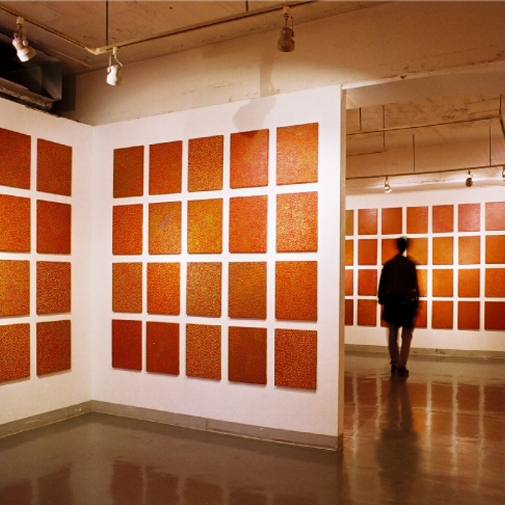
In a 2005 installation in Tokyo, Japan, called Existence as a piece Relation with the other, Kimura painted a series of repetitive circles on canvas panels that line and divide the gallery walls. Marks, dots, circles, lines, and hue travel through shifting landscapes. The installation evoked impressions of migration, layered histories and experiences, and changing perspectives. Her video composition I (2010) contemplates beauty as a state of constantly shifting awareness. In the video, moments appear transient, their physical and material manifestations are continuously dissolving, but their renewal produces duration and constancy. Kimura relies on visual expression as a means of mediating old and new identities. Through her artwork, she attends to memories, locations, literacies, and the vagaries of fragmentation as a person who considers contingency to be a valid mode of knowing and as praxis. For example, in [fill in title and date of one of these works], each time she carefully punctures the paper with incense sticks she is engaged in coaxing the contours of time. These gestures create a web of interconnected relationships bound by liberating practices and intention.
Kimura often uses bold, daring calligraphic flourishes, intense color, and layer upon layer of entangled shapes, lines, and patterned networks of markings. Light travels through and around her work in nuancing murmurs and loud bursts, as if following changes of frequency from soft to blaring. In her newest, 24-foot-long painting, [add title and date here], she begins the work with dramatic calligraphic strokes across its length, loosely framing the structure with a map of the world. Over this map, she layers tighter patterns and imagery that reference Japanese decorative patterns and mythological figures, such as Hou-ou, the phoenix, an avatar of Kanzeon (Guan Shi Yin/Avolokiteshvara), goddess of compassion.
In her artist’s statement, presented in English and Spanish, Kimura alludes to the layered landscapes of her adoptive home of Los Angeles:
I use visual communication to express unification and individuality. . . . I use art as a medium to openly communicate the individual differences among us. Ideally, there is a ripple effect. As with drops of rain in a pond, each drop forms a concentric circle that joins with another concentric circle, and this intertwining has a larger effect. Each individual mark I create enables communication and creates conversation.
Uso la comunicación visual para expresar unidad e individualidad. . . . Uso el arte para comunicar abiertamente las diferencias individuals entre nosotros. Con suerte, se genera una reación en cadena. Como gotas de lluvia en un estanque, cada gota es un circulo concentrico que se une a otro circulo concentrico, y estos encuentros generan un efecto mayor. Cada una de las marcas que creo es capaz de comunicar y establecer un diálogo.
For me, Kimura’s work reflects unanticipated qualities of Southern Californian mestizaje, indicating that, like any good border dweller, she has become accustomed to navigating the interstices and clashes of numerous cultures as they meet in shared spaces sometimes mapped by barbed wire. Her work appears imprinted by the jazz-inspired improvisations, dissonances, make-believe, and dead serious challenges that make up Los Angeles. Her experimental black-and-white mixed-media drawings, such as [give an example here], point to themes of dislocation and repeated re-placements of home, extended family, presence, and identity as a process of constant movement and transformation. Sometimes, in the constellation of dots that the artist calls “marks,” as in [give an example here], the location resembles that of Australian Aborigine paintings telling stories of the dreamtime. Her eye travels the globe, mapping the horizons of converging cultural literacies.
Kimura and I circle outside, to the tiered garden where visitors might pause and where gatherings are held. We make our way to the back edge of the garden, cross the bridge, and return to our starting point. Kimura says her sense of beauty is “always changing,” and she invites me back again.
check more works from the links below…